

AI Governance Consulting

Use AI With More Visibility, Control, and Confidence

AI is already entering your organization.

ChatGPT. Microsoft Copilot. Google Gemini. Claude. AI assistants. Agents. Automation. AI features inside business applications.

The challenge is not stopping AI.

It is making sure your organization can use it intentionally, securely, and responsibly.

First Call helps organizations establish practical AI governance around the tools, people, information, systems, and workflows already in use.

Create the guardrails. Keep the leverage.

Governance That Says Yes, Safely

AI Governance Should Enable AI—Not Shut It Down

Some organizations respond to AI by ignoring it.

Others try to ban it.

Neither approach works particularly well.

Employees will continue to discover new tools. Vendors will continue adding AI to existing applications. Departments will continue finding useful AI capabilities.

The better approach is to establish enough visibility, ownership, standards, and control to let people use AI appropriately.

That is AI governance.

The goal is not zero risk.

The goal is appropriate risk management that allows useful AI adoption to continue.
Good governance helps answer questions such as:

The Risk You Can't See Yet

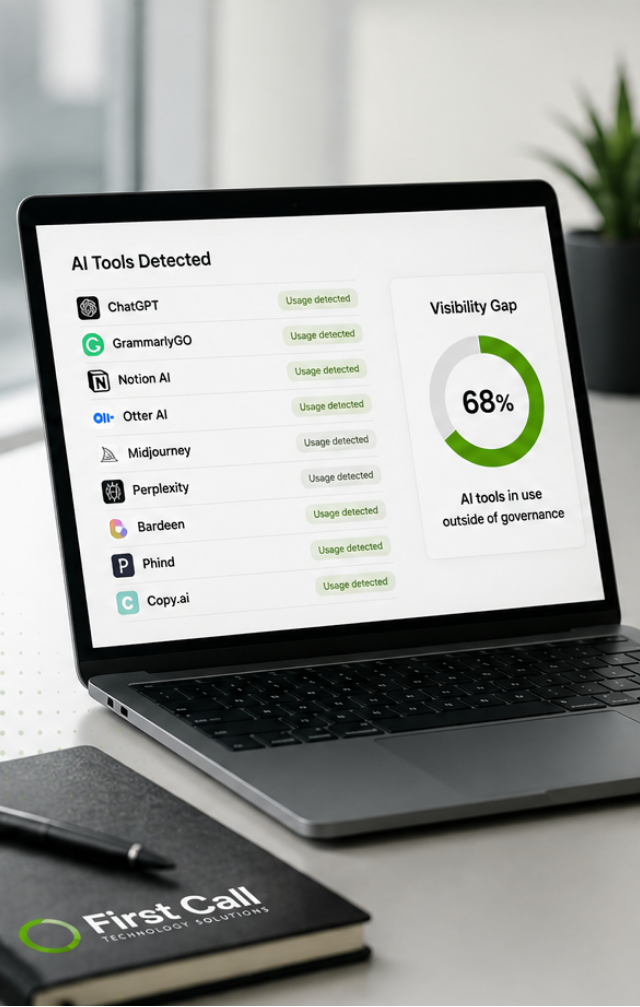
Shadow AI Is Already a Governance Issue

You may not have formally deployed AI.

That does not mean your organization is not using it.

Employees may already be using:

That creates a visibility problem.

Leadership may not know:

Your first governance objective is often not control.

It is visibility.

Step One: Decide What's Allowed

Start With Approved AI Platforms

A practical AI governance program should define what your organization actually supports.

That may include approved business versions of:

ChatGPT

Microsoft Copilot

Google Gemini

Claude

AI capabilities inside approved applications

AI agents

Automation platforms

Other business AI tools

First Call helps establish an approved AI platform standard around areas such as:

The objective is to move AI from the shadows into an intentional, manageable environment.

That is the transition from AI in the Shadows to AI Controlled in First Call's organizational maturity model.

See Where You Stand Today

Move from AI in the Shadows to AI Controlled

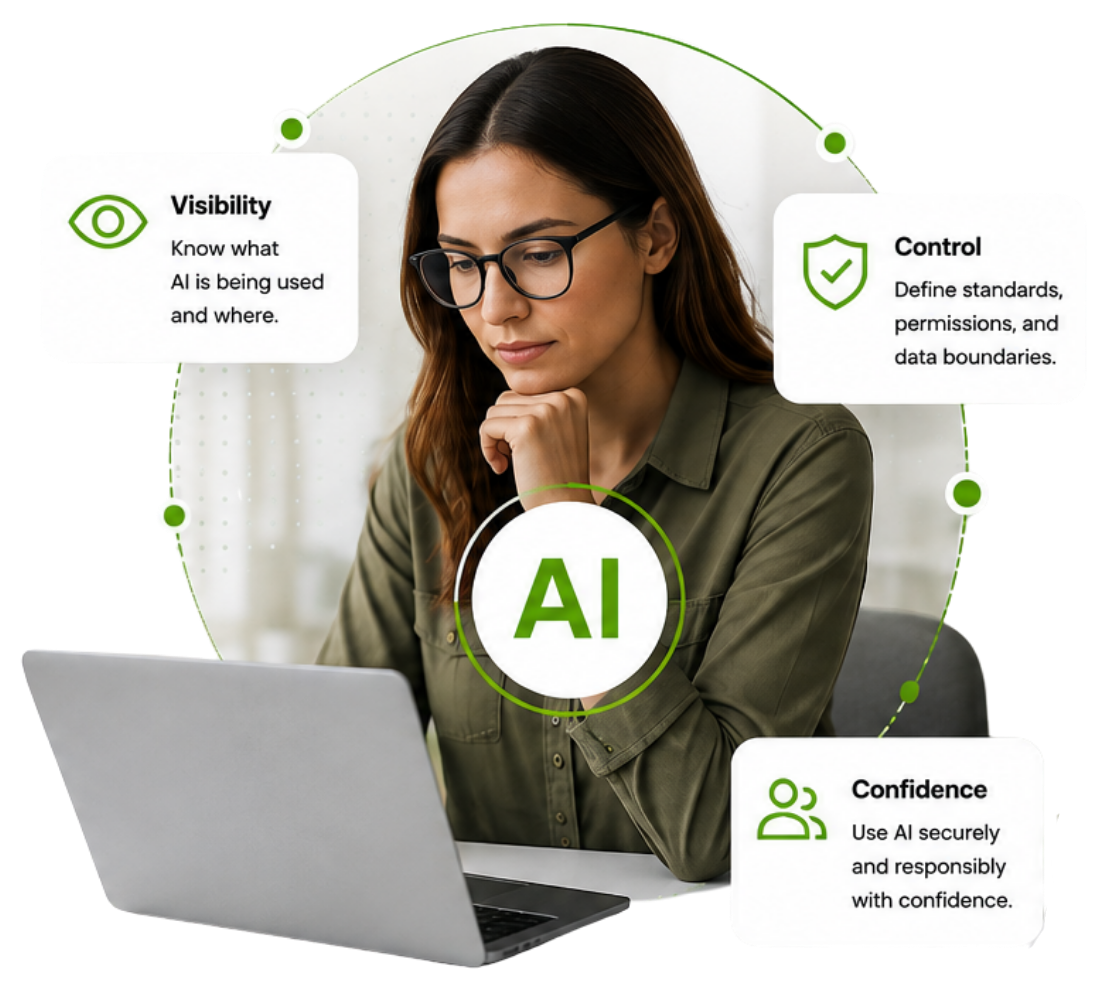
Visibility. Control. Confidence. That’s practical AI governance.

Put Clear Rules In Writing

AI Acceptable-Use Policies

Employees need practical guidance.

Not a 40-page policy no one reads.

They need to understand:

First Call can help establish an AI acceptable-use framework covering areas such as:

Governance should be understandable enough that employees can actually follow it.

Control What AI Can See

Data Governance for AI

AI becomes more powerful as it gains access to more information.

That makes data governance central to AI governance.

NIST’s Generative AI Risk Management Profile emphasizes governance as one of the core considerations for managing generative-AI risk across the lifecycle.

First Call helps organizations think through questions such as:

For Microsoft environments, this may include Microsoft 365, SharePoint, Teams, Purview, Entra, and existing Microsoft permissions.

For Google environments, it may include Workspace, Drive, Shared Drives, Groups, and related controls.

For ChatGPT and other platforms, governance may involve business workspaces, connected sources, administrative controls, and retention settings.


Control Who Can Use It

Identity, Access, and Permissions

AI should not automatically have access to everything.

Neither should the person using it.

Modern AI systems increasingly inherit, use, or connect to existing permissions.

That means identity and access management become part of AI governance.

First Call helps organizations address:

Microsoft's current Copilot governance guidance specifically emphasizes data security, AI security, compliance, privacy, oversharing, and existing access controls as part of a governed deployment.

When AI Starts Taking Action

AI Governance Is Different When Agents Can Act

Traditional AI primarily answered questions.

Agentic AI can increasingly:

That introduces a different level of risk.

CISA and international cybersecurity partners now recommend careful adoption of agentic AI, including avoiding broad or unrestricted access, starting with lower-risk use cases, and incorporating agentic AI into the organization's overall security model.

First Call helps organizations establish appropriate agent governance around:

An agent should not get unlimited access simply because it is useful.

Keep People In The Loop

Human Review Still Matters

First Call's Managed AI standards

Explicitly recognize that AI systems, agents, and automated workflows may behave unpredictably and that controls can reduce—but not eliminate—those risks.
That is why governance should define where human review is required.

The objective is not to put a human approval step around every AI interaction.

It is to put judgment where judgment matters.

Examples may include:

One Policy, Every Tool You Use

Governance Across ChatGPT, Microsoft, Google, and Other AI Platforms

Most organizations will eventually operate across more than one AI ecosystem.

That creates a governance challenge.

Microsoft

Google

OpenAI

Other AI platforms

Different platforms may have different:

First Call helps establish a common governance framework while respecting the differences between platforms.

For example, OpenAI states that business data in ChatGPT Business, Enterprise, Edu, Healthcare, and its API platform is not used to train its models by default, and provides business controls around access, connected sources, authentication, and retention depending on the offering.

The governance model should account for the actual platform—not rely on one generic AI policy.

Security And Governance, Together

AI Security and Governance Work Together

AI governance is broader than cybersecurity.

But cybersecurity is a critical part of it.

First Call's AI governance work can coordinate with our Security Services team around areas such as:

CISA continues to emphasize secure-by-design principles, data security, secure deployment, and lifecycle risk management for AI systems.

The point is not to bolt security onto AI after deployment.

It is to build appropriate security into the way AI is adopted.

Built For Audits And Oversight

AI Governance for Regulated Organizations

Governance matters even more when your organization operates under regulatory, contractual, or insurer requirements.

That may include organizations subject to requirements such as:

GLBA

FFIEC

NCUA

HIPAA

PCI

CMMC / DFARS

State privacy requirements

Federal requirements

Contractual security requirements

Cyber insurance requirements

First Call can help translate your operational environment into practical AI governance controls.

We do not replace legal counsel, compliance professionals, or regulatory advisors. We help make sure the technology, access, policies, data, and operational practices are aligned with the requirements your organization is responsible for meeting.

Track Spend Before It Sprawls

Governance Must Include Cost

AI risk is not limited to security.

AI can also create uncontrolled spend.

That becomes increasingly important with:

First Call helps organizations establish visibility into:

Governance should help prevent both uncontrolled risk and uncontrolled cost.

First Call’s AIStack Challenge specifically evaluates whether an executive sponsor or responsible leader has been identified and whether AI ownership has become part of normal organizational planning and management.

For more mature organizations, that may evolve into an AI steering group that regularly reviews:

AI governance becomes part of management—not an annual policy exercise.

Someone Needs To Be Accountable

Who Owns AI Governance?

Someone should.

AI governance cannot remain an informal side responsibility forever.

Depending on the organization, ownership may involve:

What You Walk Away With

Practical AI Governance: What We Help Establish

First Call’s AI Governance services may include:

AI Platform Standards

Define approved business AI platforms and how they should be administered.

AI Acceptable-Use Policy

Establish practical expectations for employee AI use.

Data Governance

Define what information can be used, how it should be classified, and where authoritative knowledge should live.

Identity & Access

Align AI access with business-owned identity, permissions, roles, and employee lifecycle processes.

Security Controls

Coordinate reasonable AI-specific security, filtering, monitoring, and data-protection controls.

Human Review Standards

Define where AI-generated work or automated actions require human approval.

Agent Governance

Establish ownership, access, testing, approval, monitoring, and change-control standards for AI agents.

Platform & Licensing Governance

Manage approved tools, licenses, usage, feature changes, and platform overlap.

Cost Governance

Create visibility into licensing, API, token, and consumption-related costs.

Governance Ownership

Clarify executive sponsorship, operating responsibilities, escalation, and review cadence.

Governance Before Scale

AI governance should grow with AI maturity.

You do not need an enormous AI bureaucracy on day one.

Early governance might mean:

As AI capability grows, governance may expand to include:

First Call's own maturity framework treats Stages 1 and 2 primarily as Risk and Control, before organizations move deeper into workforce capability, organizational knowledge, and operational transformation.

Build enough governance for the capability you have—and strengthen it before the capability expands.

The Point Is Still Progress

Governance Should Not Become the Goal

It is possible to govern AI so aggressively that nothing useful happens.

That is not success.

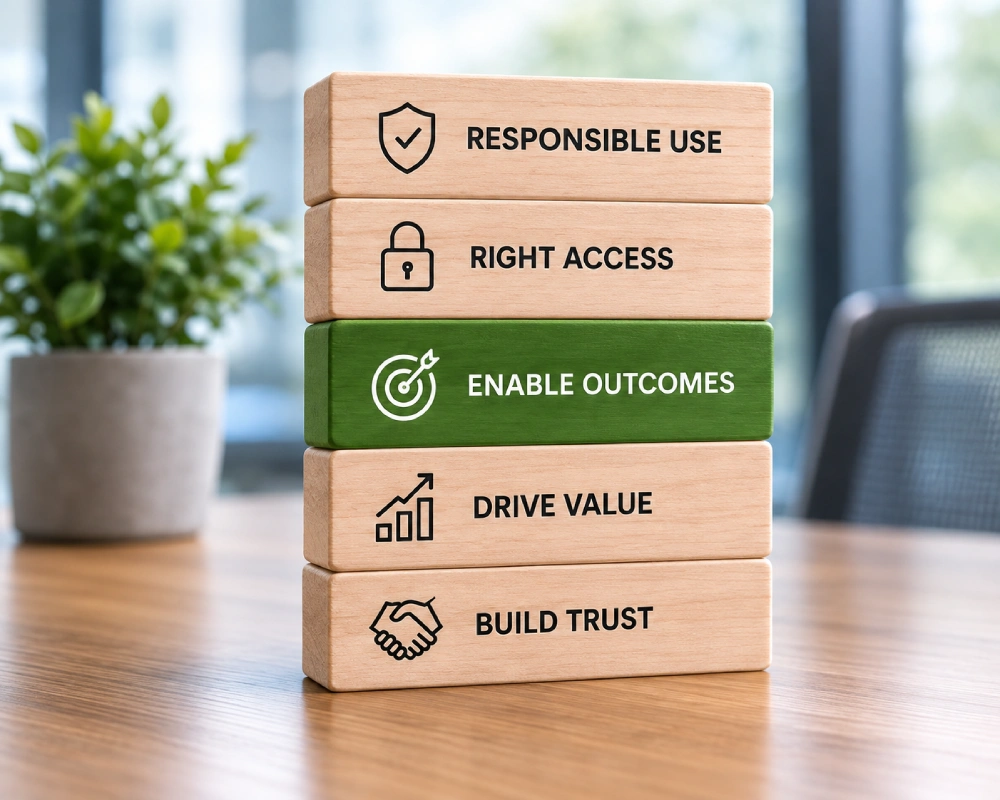
The point of governance is to create enough control to safely unlock:

In First Call's Managed AI Enablement model, Governance is one of five connected areas:

Tools

Governance

Education

Knowledge

Agents

Together, they support continuous AI improvement and better organizational outcomes.

Why Organizations Choose Us

Why First Call?

AI governance is not just a policy problem.

It touches:

That is why First Call approaches AI governance as part of the organization's broader technology and operating environment.

We work shoulder-to-shoulder with leadership, IT, cybersecurity, compliance, and operational stakeholders to create governance that is practical enough to use and strong enough to matter. First Call's broader brand promise is to lead with strategy and outcomes—not technology for technology's sake.
Start With the AIStack Challenge

Not Sure How Governed Your AI Environment Is?

Start by getting visibility.

The AIStack Challenge evaluates:

It helps leadership understand where the organization currently stands, where governance gaps exist, and where stronger control could enable greater AI capability.

What Matters Most, First

Take the AIStack Challenge

See where your AI environment is controlled—and where it is not.