

IT Services for Montana Credit Unions
Your Members Trust You With Their Financial Lives. Your IT Has to Be Worthy of That.
Credit unions face the same cybersecurity threats as banks, with fewer resources to respond. That’s not a criticism. It’s the structural reality of the cooperative model, and it shapes everything about how IT support for credit unions needs to work. First Call has supported Montana credit unions for over two decades. We build IT programs around what that environment actually requires.
A free discovery call with a First Call expert who knows the NCUA and GLBA environment. No sales pitch. You will come away with a detailed report on where your compliance and security gaps are.
Credit Unions We Work With in Montana
We Understand the Cooperative Model. That Changes How We Work.
Most of the credit unions we support aren’t facing IT problems because of poor planning. They’re facing them because compliance and security expectations placed on financial institutions have grown faster than the IT staffing models most credit unions can sustain.
The credit unions we work with tend to look like this:
- An IT team of one or two people responsible for everything from member-facing systems to security to vendor oversight.
- A core processor relationship that shapes more of the environment than the credit union controls
- A compliance program that is largely sound but hasn't been fully updated since the 2023 GLBA changes





IT Support for Credit Union Leadership and IT Teams
Where You Sit Shapes What You Need From Us
Where you sit in the credit union shapes which IT and compliance decisions are yours to make. Tell us which one fits and we will point you to what is most relevant to your situation.

For Your IT Team
If you are the one or two people responsible for everything from member-facing systems to security to vendor oversight, you do not need a replacement. You need depth and backup in the moments a small team gets stretched: a security incident, a core migration, or a vendor due diligence program that has grown past what one person can track. Our Done With You IT model works alongside you and keeps you in control.

For Leadership and the Board
If you are the CEO, a board member, or the compliance officer, your exposure is different. You are the one answering to examiners, and to members, if something goes wrong. This section of the page covers what you need to make informed decisions about NCUA and GLBA readiness without a technical background. If your credit union has no internal IT function, our Done For You IT model covers the whole environment.
A free call with a First Call expert. You will come away with a detailed report on where your biggest compliance and security gaps are.
Why Credit Union IT Is Harder Than It Looks
The Same Regulatory Weight as Banking, With a Leaner Resource Base to Carry It
The compliance framework for credit unions is substantive and examiner-enforced. NCUA cybersecurity guidance, GLBA requirements, and state credit union regulatory expectations all require active, ongoing management. For non-federally insured credit unions subject to FTC jurisdiction, the FTC’s updated GLBA Safeguards Rule requires a written information security program, a designated qualified individual to oversee it, documented risk assessments, and administrative, technical, and physical safeguards that are regularly tested, monitored, and updated.
Most Montana credit unions operate with smaller IT budgets and leaner IT teams than comparably sized banks. Third-party core processors set the integration architecture for everything else, but the credit union’s IT team is still responsible for the surrounding environment, endpoints, network, security controls, and vendor oversight program. Shared branching networks add another integration layer. Rural connectivity across Montana adds complexity for credit unions serving members across multiple counties.
Where Montana Credit Union IT Risk Concentrates
Four Patterns That Show Up Across Credit Union Environments

Vendor management spread across too few hands
Between the core processor, shared branching network, online banking platform, mobile app provider, and ancillary tools, most credit unions manage 20 or more technology vendors. Tracking due diligence, contract terms, and security assessments across all of them is a significant program to run with a small IT team.
Security posture calibrated to a smaller threat environment than actually exists
Credit unions face the same threat vectors as banks: Business Email Compromise, credential phishing, ransomware. Attackers don’t discount credit unions for being smaller. The security controls protecting against those threats need to match the actual risk.

Compliance documentation that lags behind system changes
When a new platform gets added or a configuration changes, the documentation doesn’t always keep pace. Examiners notice when what’s on paper doesn’t match what’s running. That gap creates findings that require follow-up visits to close.
IT capacity that becomes visible only during projects and incidents
A one- or two-person IT team can keep day-to-day operations running. What they can’t easily do is run a system migration, respond to a security incident, and handle normal support requests simultaneously. Capacity constraints show up at exactly the moments when full capacity is most needed.
If any of these patterns describe your environment, the TechStack Challenge is a practical first step toward understanding what’s actually happening and what matters most to address.
NCUA Compliance IT Support for Montana Credit Unions
The Examiner's Questions Are Specific. Your Answers Need to Be Too.
NCUA examiners use the Cybersecurity Assessment Tool to evaluate maturity across five domains: cyber risk management and oversight, threat intelligence and collaboration, cybersecurity controls, external dependency management, and cyber incident management and resilience. Documented evidence of active controls satisfies those questions. General assurances do not.
GLBA’s Safeguards Rule requires a written information security program with a named Qualified Individual responsible for it, annual risk assessments, specific technical controls including multi-factor authentication and encryption, an incident response plan, and oversight of service providers. The 2023 updates set specific implementation requirements that many credit unions are still working through. State credit union regulatory requirements add a Montana-specific layer alongside the federal framework.

Free 30-Minute Compliance Reality Check
The 30-minute Compliance Reality Check helps credit union leadership and IT teams understand where their current compliance posture stands before a formal examination. It’s a useful internal baseline that costs nothing and takes half an hour.
Free resource. 30 minutes. A clear picture of where your compliance program stands.

IT Support Services for Montana Credit Unions
Built Around Member Service, Regulatory Requirements, and the Reality of Credit Union Budgets
Core processor integration and surrounding environment
Whether your credit union runs on Symitar, Corelation, Fiserv Credit Union Solutions, or another platform, we manage the infrastructure and integrations surrounding your core. Your IT team stops being the intermediary between your core provider and everything else.
Security monitoring and incident response
Continuous monitoring, endpoint protection, email security, and a documented incident response plan aligned to your NCUA and GLBA obligations. For credit unions that need a deeper security program, our Advanced Cybersecurity service covers vCISO support, SIEM, and financial services-specific security engineering.

Vendor risk management support
We help maintain your vendor inventory, track due diligence documentation and security assessments, and flag contracts and oversight gaps before they become examination findings. We make vendor management a continuous program rather than a pre-exam scramble.

Full management or co-managed support
Credit unions without dedicated IT staff work with us through Done For You IT. Credit unions with an internal IT lead who needs backup work with us through Done With You IT. Both models are built around the compliance and operational requirements of member-owned financial institutions.
Compliance documentation and exam readiness
Every system and configuration in your environment is documented to a standard that reflects how things actually run. When examiners ask for your information security program, risk assessment, or incident response plan, those documents exist and they’re current.
Cybersecurity for Montana Credit Unions
The Threats Are the Same as Banking. The Resources to Defend Against Them Often Aren't.
Credit unions face the same threat vectors as banks: Business Email Compromise targeting wire transfers and vendor payments, credential phishing aimed at staff with access to member accounts, ransomware timed around operational pressure points. Attackers targeting financial institutions don’t adjust their methods based on asset size or charter type.
- What differs is that many credit unions are defending against those threats with fewer dedicated security resources than peer banks.
- The security program needs to be designed around that reality, with monitoring and response capabilities that don't require a full-time security operations team to maintain.
Advanced Cybersecurity Program
Our Advanced Cybersecurity program for Montana credit unions covers:
- Email authentication and BEC prevention
- Multi-factor authentication across all member-facing and staff systems
- 24/7 monitoring with financial services-specific detection logic
- Incident response planning aligned to your NCUA and GLBA notification obligations
- Security awareness training built around the phishing patterns that actually target credit union staff
Done For You IT vs Done With You IT for Montana Credit Unions
Most Credit Unions Fit One of These Models Clearly. Here's How to Tell Which One.

Done For You IT
Credit unions without a dedicated internal IT function work with us through Done For You IT. First Call takes complete responsibility for the IT environment: infrastructure management, security, vendor coordination, compliance documentation, and day-to-day member-facing system support. The right fit for credit unions where IT is currently managed by staff who have other primary responsibilities, or where the setup has grown beyond what a part-time arrangement can sustain.

Done With You IT
Credit unions with an internal IT lead work with us through Done With You IT. Your IT lead stays in control of the environment and the decisions. We provide engineering depth, security expertise, and project capacity in the areas where a small team is stretched. This works particularly well when your IT lead is carrying security and vendor management alongside infrastructure and support, and needs a capable team behind them rather than a replacement.
20-minute working session. No sales pitch. You’ll leave with a clear picture of where things stand.
IT Services for Montana Credit Unions: Why First Call
We've Supported Montana Credit Unions for Over 20 Years. We Understand the Cooperative Model.
Most IT providers treat financial institutions as a compliance category. We treat credit unions as what they are: member-owned cooperatives where IT decisions have direct consequences for the people the institution exists to serve. That changes what we pay attention to and how we frame the work.
We’ve supported Montana credit unions in Missoula, Bozeman, Billings, Kalispell, Great Falls, Helena, Butte, and smaller communities across the state.
We’re familiar with the NCUA examination environment, the core processor landscape that Montana credit unions operate on, and the budget discipline that member-owned institutions apply to every IT decision. Every environment we manage is documented to a level where any engineer on our team can pick up where another left off.
Advanced Cybersecurity Program
For credit unions with more complex security requirements or examination pressure around their cybersecurity program, we provide vCISO support through our Advanced Cybersecurity service:
- A named security advisor who understands NCUA guidance
- Reviews your program
- Helps you prepare for examiner conversations with specific evidence rather than general assurances.
Work With a Montana IT Partner That Understands Credit Unions
Let's Start With an Honest Look at Where Your IT Stands
The TechStack Challenge is a 20-minute working session. We look at how your systems are structured, where your compliance documentation has gaps, and what your highest-priority items are. You leave with a clear picture of what’s working, what isn’t, and what to address first.
If you’d prefer to start with a self-assessment, the 30-minute Compliance Reality Check covers the same ground in a format your team can work through independently. Montana banks and financial services organizations across the state use the same framework.
20-minute working session. No sales pitch. You’ll leave with a clear picture of where things stand.
Blogs & Recent News
Insights for Credit Unions and Financial Teams
FTC Safeguards Rule and WISP Requirements for Montana Accountants
Most accounting firms in Montana already know they need to
Why Financial Firms Are Prime Cybersecurity Targets
Cybercriminals target financial organizations because financial data is immediately valuable.
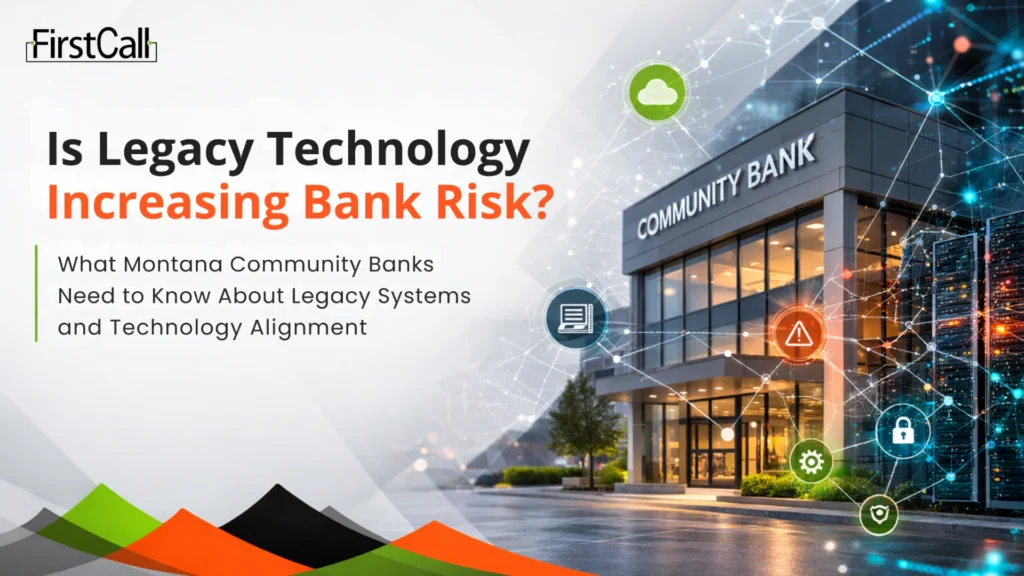
Legacy Tech Is Undermining Montana Banks
When people hear the phrase legacy systems, they often imagine ancient software running on dusty servers in a back room. Sometimes that is true. More often, legacy technology looks much more ordinary.
IT Services for Montana Credit Unions: Frequently Asked Questions
Questions We Hear Most Often
NCUA examiners use the Cybersecurity Assessment Tool to evaluate maturity across five domains: cyber risk management and oversight, threat intelligence and collaboration, cybersecurity controls, external dependency management, and cyber incident management and resilience. Preparation means having documented policies and controls that reflect how your systems actually operate, an active vendor management program with current due diligence records, a tested incident response plan, and evidence that your board and senior leadership are engaged in cybersecurity governance.
GLBA applies to credit unions as financial institutions. The Safeguards Rule requires a written information security program, a designated Qualified Individual responsible for overseeing it, annual risk assessments, and specific technical and organizational controls. The 2023 FTC updates added requirements around multi-factor authentication, encryption, access control reviews, vulnerability management, and incident response. Credit unions that haven't fully updated their programs to meet the 2023 requirements should treat that as a near-term priority.
We manage the infrastructure and integrations surrounding your core platform. Whether you're on Symitar, Corelation, Fiserv Credit Union Solutions, or another system, we document how your core connects to the rest of your environment, manage the surrounding network and endpoint infrastructure, and coordinate with your core vendor when issues arise at the integration layer.
Done For You IT is the right fit for credit unions without dedicated internal IT staff that want First Call to manage the environment completely. Done With You IT works for credit unions with an IT lead who needs additional capacity, engineering depth, and security expertise. Your IT lead stays in control of decisions. We provide the team behind them. The TechStack Challenge will help clarify which model fits your current situation.
Yes. Shared branching creates additional integration points that need to be secured and monitored. We account for shared branching in the security architecture and make sure the controls protecting member transactions across the network are documented and maintained.
Vendor management is a formal program requirement under both GLBA and NCUA guidance. We help maintain your vendor inventory, track security assessments and due diligence documentation, monitor contract terms and renewal dates, and flag oversight gaps before they surface in an examination.
The threat vectors are largely the same: Business Email Compromise, credential phishing targeting staff with account access, and ransomware timed around operational pressure points. What differs is that credit unions often have fewer dedicated security resources to defend against those threats. Our Advanced Cybersecurity program is specifically designed to provide strong security coverage in environments where a full internal security team isn't practical.
We work with credit unions across Montana, including in Missoula, Bozeman, Billings, Kalispell, Great Falls, Helena, Butte, and surrounding communities. The TechStack Challenge is the right starting point. You can also review how we work with Montana banks and financial services organizations more broadly.