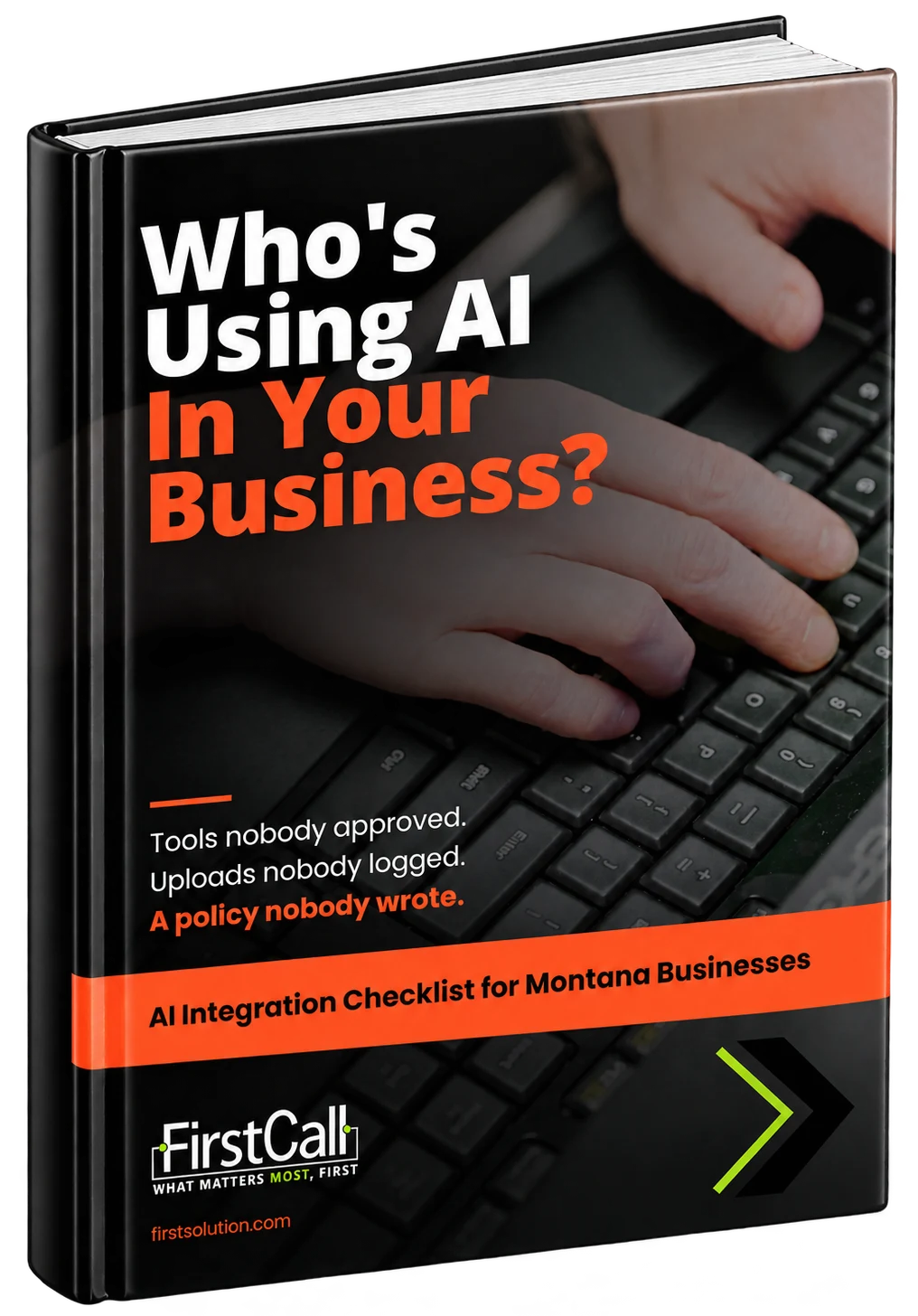
Who’s Using AI In Your Business?
The AI Integration Checklist for Montana Businesses
Somebody on your team used an AI tool this week. Probably several people, on several tools, with company data. This free checklist scores how well the business can see that, control it, and answer for it when an insurer or a customer asks.
Free PDF, delivered instantly. 13 pages, about 30 minutes to complete. No meeting is booked automatically.

Employees using AI at work
Shadow AI arrived before the policy did
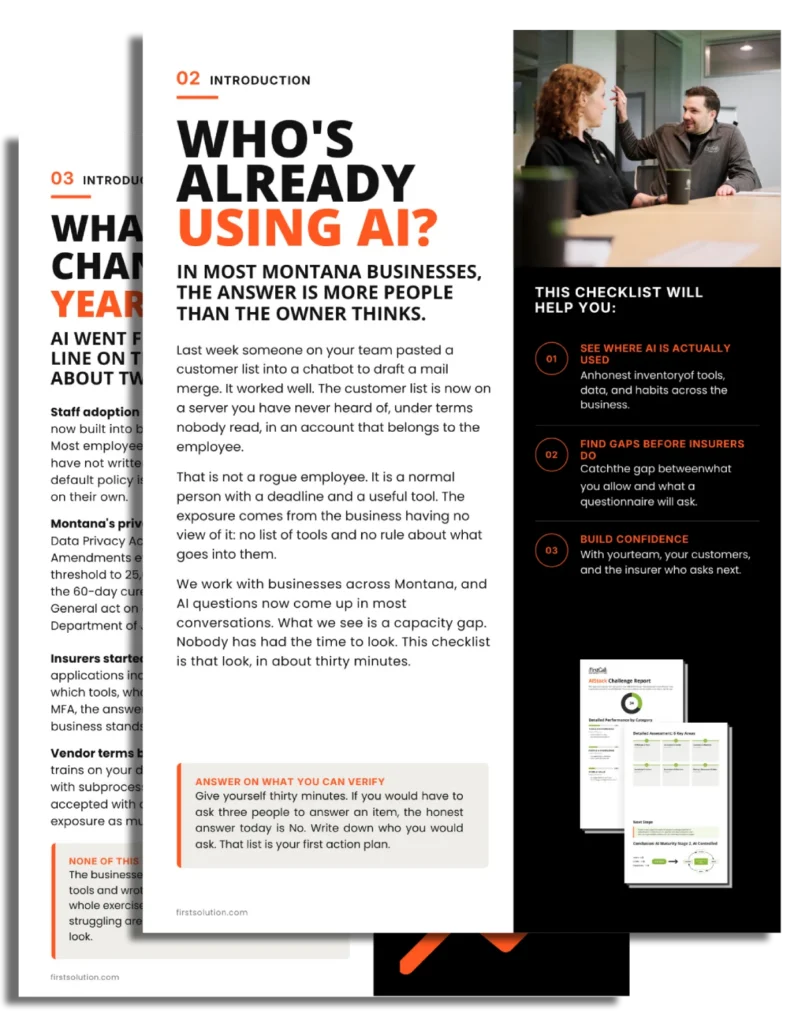
Last week someone pasted a customer list into a chatbot to draft a mail merge. It worked well. The customer list is now on a server you have never heard of, under terms nobody read, in an account that belongs to the employee.
That is a normal person with a deadline and a useful tool. The exposure comes from the business having no view of it.
The outside world has started asking. Montana’s Consumer Data Privacy Act now reaches businesses holding data on 25,000 Montana consumers, and the cure period ended in October 2025 (Montana Department of Justice). Cyber insurance applications increasingly include questions about which AI tools you use and what governs them. Those answers need to exist, and they need to be accurate.
AI Integration Checklist
Six sections. Forty-eight items. One score.
A practical guide to help you adopt AI with clarity and control.
This checklist includes:
Each section is one page: eight items you can verify, a note on what we see in Montana businesses, and the documents that prove it.
- AI Tool Awareness. Which tools are in use, on which devices, for what work.
- Data Exposure. What is going into prompts and uploads, and what stops it.
- Policies & Governance. Whether the rules are written, current, and acknowledged.
- Vendor & Contract Terms. What each vendor may do with your data, and whether anyone has read it.
- Compliance & Insurance. Montana’s privacy law, your privacy notice, and the AI questions on your renewal.
- Incident Readiness. What happens when a tool leaks, an account is compromised, or a cloned voice calls accounts.
You also get a What Changed page on the law and the insurers, a scoring guide, and a next-steps page you can act on without us.
A preview of the items
- We keep a written list of AI tools in use, with who uses each one and for what tasks.
- Approved AI tools are on business plans where our data is not used to train the vendor’s models.
- We have a written AI acceptable use policy, and every employee has read and acknowledged it.
- For each approved tool, we know whether our inputs can be used to train the vendor’s models.
- Our last cyber insurance application answered any AI questions accurately, and we can show the evidence.
- Payment and account changes are verified by callback, because voice and video can now be faked.
Only a Yes scores a point. “We probably do that” is a Partially.
AI policy for small business
Owners and managers, not IT departments

Written for the person who would have to answer an insurer, a customer, or a regulator about AI use in the business. No technical background needed. It works best with three people in the room: whoever runs IT, whoever handles customer data, and someone from the team most likely already using AI.

AI readiness score
Four bands, and what to do in each
0 to 20, High Risk
AI is in use with no inventory and no rules about data. The exposure is real and unmanaged.
21 to 32, Needs Improvement
Some visibility exists, but policy, vendor terms, and insurance answers do not yet line up.
33 to 40, Moderate Readiness
Most of the structure is in place. What remains is paperwork: vendor files, acknowledgments, and the insurer’s answers.
41 to 48, Strong Readiness
AI use is known, governed, and documented. Keep the inventory current as tools change.
Scored under 33? Your lowest section is where the exposure lives, and that is what the AIStack Challenge is for.
Free AI risk assessment
Bring your results to the AIStack Challenge

Assess
We review your checklist results and your tool inventory, including the ones you were unsure about.
Identify
We confirm which tools and data flows create real exposure and which are fine as they are.

Plan
You get a prioritized set of next steps ordered by data risk and renewal timing.

Empower
You leave with a written summary and a one-page policy outline, not a sales pitch.
Why Businesses Trust First Call
You get support from people who understand your world and care about protecting it.
Real Results From Local Teams
“First Call has been a great company to work with for the last several years. Customer service is excellent, response time is quick, and they have always been responsive to the tech needs of our company. I would highly recommend them to anyone.”
— Jeanne West
When you download this checklist, you also get:
Find out who’s using AI before someone else asks
Download the checklist, score it in thirty minutes, and bring the result to a 20-minute call.
Frequently Asked Questions
About thirty minutes if the right three people are in the room. Longer if nobody has asked the team what they use yet, which is itself an answer.
No. It is written for the owner or manager. Every item is a plain statement you can mark Yes, Partially, or No.
The PDF arrives immediately. Nobody books a call unless you do.
Yes. Twenty minutes, live, with a written summary afterward.
No. Section 1 is how you find out.
Yes, even a one-page one. Insurers and customer contracts increasingly ask for it, and Section 3 of the checklist shows exactly what yours needs to cover.