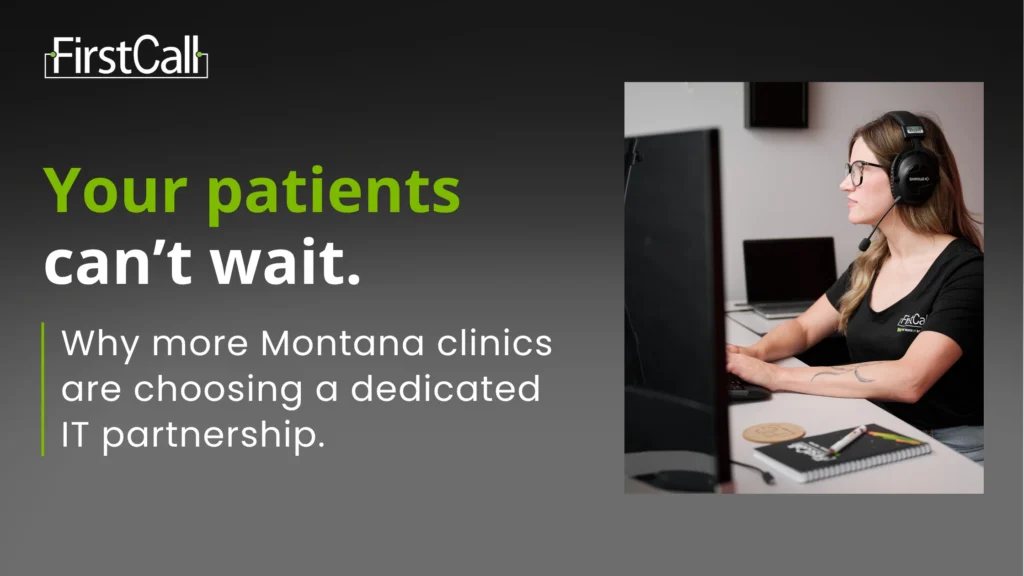
Healthcare organizations depend on IT differently than most industries do. A patient record that goes inaccessible for an hour can delay actual patient care. A missed security patch means protected health information sitting exposed, a real compliance and patient-trust problem, not a hypothetical one. That is why more Montana hospitals, clinics, and healthcare nonprofits are moving to a dedicated IT partnership instead of treating technology as an occasional fix, brought in only after something has already gone wrong.
Compliance Does Not Run Itself
HIPAA compliance touches nearly everything a healthcare organization’s IT systems do: how patient data is stored, who can access it, how it moves between systems, and what happens if a device gets lost or stolen. Meeting these requirements takes ongoing work, not a one-time setup. A dedicated IT partner keeps that work current instead of letting it slide until an audit or an incident forces the question.
That ongoing work includes things that are easy to let slip when there is no one specifically responsible for them: reviewing who still has access to patient records after a role changes, confirming backups actually restore rather than just run, and keeping a written incident response plan current rather than filed away and forgotten.
If you want a quick, practical starting point, our 10-Minute HIPAA Website Readiness Check walks through the basics most healthcare websites get wrong, and it takes about as long to complete as the name suggests.
What a Breach Actually Costs a Healthcare Organization
A data breach involving patient information is not just an IT problem to clean up quietly. Under HIPAA, a breach affecting patient data triggers specific notification obligations, to affected patients, and in many cases to the Department of Health and Human Services directly. Larger breaches can also mean public notification and, depending on the circumstances, a federal investigation.
Beyond the reporting requirements, there is the harder cost to measure: patient trust. A clinic or hospital that has to tell its patients their information was exposed is starting the next conversation with them from a different place. Preventing that situation is almost always less expensive, and far less disruptive, than managing the aftermath of one.
Patient Care Does Not Pause for IT Problems
A retail business can usually absorb a few hours of network downtime. A clinic cannot always say the same. Scheduling systems, electronic health records, and communication tools all need to stay available during patient care hours, and problems that come up outside normal business hours still need a response. Healthcare organizations need IT support built around when patients actually need care, not a standard nine-to-five help desk.
This matters just as much for smaller practices as it does for hospitals. A single-provider clinic with no in-house IT staff often feels a short outage more acutely than a larger organization would, since there is no one else on-site who can troubleshoot while patients wait.
Protecting Patient Data Without a Full-Time Security Team
Most healthcare organizations, especially smaller clinics and healthcare nonprofits, do not have the budget for a full-time in-house security team. An IT partnership fills that gap. Monitoring, patching, and access controls become the partner’s ongoing responsibility instead of a task competing with patient care for someone’s attention at the end of a long week.
A Partner That Understands Healthcare’s Actual Constraints
Generic IT support treats every client the same. Healthcare has its own constraints: strict compliance requirements, sensitive data, tight budgets at nonprofits and rural facilities, and systems that cannot go down during patient care. A good IT partner builds around those constraints from the start rather than applying a standard approach and hoping it fits.
Evaluating a provider matters just as much here. Ask specifically about HIPAA experience, response times during and outside business hours, and whether they can name other healthcare clients they currently support. A provider that cannot speak specifically to healthcare constraints is likely applying the same playbook to every industry they work with, healthcare included almost as an afterthought.
What We Have Seen Work in Montana Healthcare
We have worked alongside healthcare organizations across Montana, including Mineral Community Hospital, Bullhook Community Health Center, and Partners In Home Care, each with a different setup and a different set of constraints. What they have in common is the same underlying question: how to keep patient care running smoothly without carrying the full weight of IT internally. Our case studies cover the specifics of how each partnership actually works day to day, including what changed in the first few months and what each organization’s team no longer has to worry about.
Frequently Asked Questions
Why do healthcare organizations need a specialized IT partner instead of general IT support?
Healthcare IT involves compliance requirements, patient data sensitivity, and uptime needs that general business IT support is not always built around. A specialized partner understands HIPAA requirements and clinical workflows, not just general troubleshooting.
What does HIPAA compliance actually require from an IT standpoint?
Ongoing safeguards for how patient data is stored, accessed, and transmitted, along with access controls, encryption, and a documented response plan for a potential breach. It is continuous work, not a one-time setup.
Can a small clinic or healthcare nonprofit afford a dedicated IT partnership?
Often it costs less than the alternative. Building an equivalent in-house team, security tooling, and compliance program internally is usually more expensive than partnering with a provider who already has that infrastructure in place.
What should a healthcare organization look for when evaluating an IT provider?
Ask specifically about HIPAA experience, response times during and outside business hours, and whether they can name other healthcare clients they support. A provider that cannot speak specifically to healthcare constraints is likely applying a generic approach.
Does this apply to healthcare nonprofits, not just hospitals and clinics?
Yes. Healthcare nonprofits face many of the same data sensitivity and compliance considerations as clinics and hospitals, often with smaller budgets and thinner internal IT support to begin with, which makes a dedicated partnership even more valuable relative to its cost.
Take the Next Step
Not sure where your own IT setup has gaps that could affect compliance or patient care? The free TechStack Challenge gives you a clear picture in about 20 minutes, no sales pitch.