
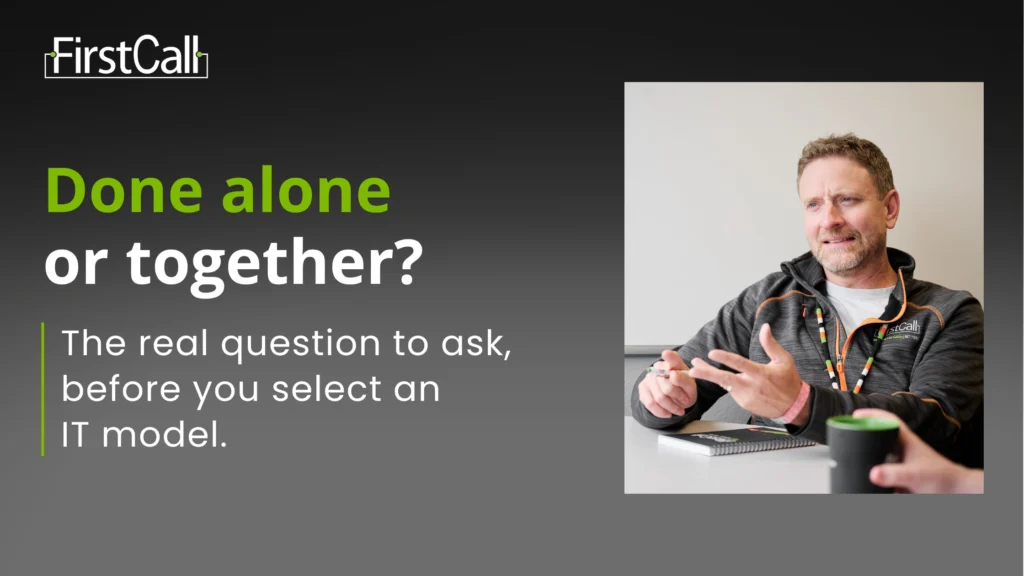
Every healthcare organization or nonprofit looking at outside IT support ends up choosing between two models. Done for you means a provider takes over IT entirely. Done with you means a provider works alongside the internal team you already have. Neither model is better in general, despite what a lot of comparison articles imply. The right choice depends on whether you already have internal IT staff, and what you want that staff focused on if you do.
What Done For You Actually Means
A fully outsourced, done for you arrangement puts one provider in charge of your entire IT environment: help desk support, security, backups, vendor management, and day to day troubleshooting. There is no internal IT department to coordinate with, because the provider is the IT department.
This model tends to fit smaller clinics and healthcare nonprofits that have never had internal IT staff and do not plan to hire any. Rather than building a department from nothing, the organization gets a full team on day one.
What Done With You Actually Means
A co-managed arrangement works differently. Your existing IT staff stay right where they are, handling the parts of the job they already know best, while a partner takes on the pieces that would otherwise take too much time to build in-house: after-hours monitoring, specialized security work, or a compliance project that needs more hands than your team currently has. That split gets mapped out task by task before the partnership starts, in writing, rather than sorted out informally the first time something breaks.
This model tends to fit larger clinics, hospitals, and healthcare nonprofits that already have one or more internal IT staff who understand the organization’s specific systems and workflows, but who need extra specialized coverage for security, compliance, or a major project their current team does not have time to take on alone.

When Done For You Makes Sense
If your organization has no internal IT staff today and no near-term plan to hire any, done for you is usually the more practical starting point. It gives you full coverage immediately, without the cost and time of building an internal team first.
When Done With You Makes Sense
If you already have internal IT staff, even just one person, done with you usually makes more sense than replacing them. Co-managed IT lets your existing staff keep the institutional knowledge they already have about your systems and your organization, while a partner covers the gaps: after-hours coverage, specialized security work, or compliance requirements that would otherwise fall entirely on one person’s plate.
We have written in more detail about the specific problems co-managed partnerships run into when responsibilities are not clearly divided, and about what healthcare organizations specifically need from an IT partnership, whichever model they choose.
A Practical Way to Decide
If you are still not sure which model fits, a few honest questions usually settle it faster than reading another comparison article:
- Do we have anyone on staff today whose job includes IT, even partially? If not, done for you is almost always the simpler starting point.
- Is that person spending most of their time on routine tickets, or on work specific to how our organization actually operates? The more specific knowledge they hold, the more a co-managed model protects that investment.
- Where would a security incident or a compliance gap most likely go unnoticed right now? That answer usually points to exactly what a partner should own first.
- Could our current staff describe, in writing, what they are responsible for versus what an outside partner would be? If the answer is no, that gap needs to close before either model will work well.
What Does Not Change Between the Two Models
Compliance obligations do not go away under either model. Patient data still needs to be protected the same way, and uptime for clinical systems matters just as much, regardless of whether your IT is fully outsourced or co-managed. What changes is who owns which piece of that work, not whether the work needs to happen.
The same is true of cost predictability, response expectations, and reporting. A good provider sets those expectations clearly under either model. If a provider cannot describe response times, escalation paths, or what you will actually see in a monthly report before you sign anything, that is worth treating as a warning sign regardless of which model you are considering.
Frequently Asked Questions
What is the difference between done for you and done with you IT support?
In a done for you arrangement, one provider handles everything, with no internal IT staff involved. In a done with you arrangement, your internal team stays in place and a provider covers specific gaps, agreed on in advance rather than figured out as problems come up.
Which model is better for a small healthcare nonprofit?
It depends mainly on whether the organization already has internal IT staff. Without any, done for you usually makes more sense. With even one internal IT person, done with you typically preserves more value from the knowledge that person already has.
Does switching to a co-managed model mean replacing our current tools?
Not necessarily. A good co-managed partner works inside the systems you already have where that makes sense, rather than requiring your team to learn new tools on top of an already full workload.
Can an organization switch between the two models later?
Yes. Many organizations start with a done for you arrangement and shift to co-managed once they hire their first internal IT person, or the reverse, moving to fully outsourced once an internal team member leaves and is not replaced. Neither move requires starting the relationship over from scratch.
Does compliance work differently under a co-managed model?
The compliance requirements themselves do not change. What changes is who is responsible for specific pieces of it, which is why a documented ownership map between the internal team and the partner matters as much for compliance as it does for day to day support.
Take the Next Step
Not sure which model actually fits your organization? The free TechStack Challenge gives you a clear picture of your current setup in about 20 minutes, no sales pitch.