

Cybersecurity and Compliance Services for Montana Businesses
How Confident Are You in Your Security Posture?
Most organizations we work with aren’t sure. They have some protections in place, they know there are probably gaps, but they haven’t had an independent look at where they actually stand. Security and compliance aren’t just IT concerns. A breach, a failed audit, or a regulatory penalty affects the whole business. The Security Stack Challenge gives you a clear, honest picture of your current posture without any obligation to act on it.
A short, guided conversation. You’ll leave with a clear picture of your risk, your gaps, and what to address first.
- Working toward CMMC, HIPAA, or another compliance framework? Book a compliance strategy call.
- Dealing with an active incident? Don't wait. Call us now.
Table of Contents
Let's Get to Know Where You ARe
Where Do You Want to Start?
Different Concerns Depending on Your Role
Where you sit in your organization shapes what cybersecurity decisions are yours to make. Tell us your role and we’ll point you toward the information most relevant to your situation.
IT Directors
First Call's co-managed cybersecurity approach works alongside your existing function. We're not here to take over. We're here to give you the depth and coverage your team needs to operate at a higher level. If you're evaluating whether a vCISO would strengthen your program, that's covered further down this page.

Business Owners and C-Level
If a breach happened tomorrow, you'd be fielding the board call, the regulatory notification, and the customer conversation. This page covers what you need to make informed decisions about your risk posture, without needing a technical background. If you don't have an internal IT function and need fully managed IT alongside your security program, Done For You IT covers that.
Why Most Security Programs Fall Short
Having the Tools Is Not the Same as Running the Program
Most organizations that come to us for a security assessment have tools in place. EDR, firewalls, maybe a SIEM. What they often don’t have is someone actively watching those tools, documented evidence that they’re configured correctly, and a defined process for acting when something is flagged. A security stack that nobody’s managing is a line item, not a program.
Active monitoring vs installed tools
Installed security software that isn't actively monitored doesn't protect you. It generates alerts that nobody acts on and gaps that don't get found until something goes wrong.
Compliance vs security
Compliance tells you what controls you need to have. Security tells you whether those controls are working. Many organizations achieve one without the other. The goal is both.
Documentation that survives a staff change
If your security posture depends on one person's knowledge of how things are configured, it's fragile. A security program needs to be documented and auditable, regardless of who's managing it.
Point-in-time vs continuous
An annual security review tells you where you stood on that day. Continuous management tells you where you stand right now. The threat landscape doesn't work on an annual review schedule.
- This is what the SecurityStack Challenge is designed to surface. Book yours here.
How We Work With You
Assessment, Roadmap, Implementation, Ongoing Security
Every cybersecurity engagement with First Call follows the same four-stage progression, regardless of where you’re starting from:
We start with an honest evaluation of your current posture against your actual risk profile and regulatory obligations. You leave with a clear gap analysis, not a sales pitch.
We prioritize the highest-risk gaps first and build a practical roadmap that fits your budget and operational capacity. Compliance requirements shape the sequencing where they apply.
We implement the controls, tools, and processes in the roadmap. For most organizations this means working through our Advanced Security Agreement tiers, starting with foundational controls and building from there.
Once the program is in place, we manage it continuously. Monitoring, response, compliance maintenance, and vCISO oversight run as an ongoing managed function rather than a point-in-time engagement.
A short, guided conversation. You’ll leave with a clear picture of your risk, your gaps, and what to address first.
CMMC Readiness for Montana DOD Contractors
If You Handle Federal Contracts, This Section Is for You
If your organization holds DOD contracts or handles Controlled Unclassified Information, CMMC compliance is no longer a future concern. The phased rollout is active. Contracts are beginning to include CMMC requirements, and the gap between where most small and mid-sized DOD contractors currently stand and where they need to be is significant.
First Call supports DOD contractors through the full CMMC readiness process. We understand the journey, not just the framework.
A DOD contractor that lands on a general cybersecurity page and has to guess whether the provider understands the CMMC journey is a DOD contractor who calls someone else. If this is your situation, we’d rather have a direct conversation about where you are and what the path looks like.
Download the CMMC Readiness Checklist to see where you stand before the call.
- Download the CMMC Readiness Checklist for a practical starting point on understanding your current posture against CMMC Level 2 requirements.
Assessment and scoping
- CUI scoping and boundary definition
- NIST SP 800-171 gap assessment
- SPRS score readiness and affirmation preparation
- Level 1 self-assessment support
- Level 2 C3PAO readiness preparation
Documentation and compliance operations
- System Security Plan (SSP) development and maintenance
- Plan of Action and Milestones (POA&M) support
- Evidence collection and policy documentation
- Ongoing compliance operations after assessment
- Audit participation and vCISO support
What Is Included in an Advanced Security Agreement?
The Services That Make Up a Managed Security Engagement
An Advanced Security Agreement with First Call is structured around four service tiers. Most organizations start with the foundational tier and add layers as their requirements grow. The right combination depends on your size, your industry, and your compliance obligations.
TIER 1
Foundational controls
- Endpoint Detection and Response (EDR): deployment, configuration, and ongoing monitoring
- Desktop application patch management: automated updating of applications across managed devices
- Multi-Factor Authentication enforcement
- Backup review and verification
- Security awareness training
- Support for compliance reporting, audit readiness, and regulatory documentation
TIER 2
Managed detection and response
- SIEM configuration: devices set up for log collection, with automated log aggregation
- Log retention as specified in your agreement
- SOC Response Desk: remote resolution of security events
- Remote monitoring and alerting
- Response to generated alerts based on severity
- Alerting in accordance with your organization's incident response plan
- Managed Detection and Response (MDR): active threat detection and response
TIER 3
Compliance operations
- Security Alignment Manager (SAM) sessions: pre-scheduled, documented, and structured around your compliance requirements
- IT security standards auditing and proactive alignment
- Risk reduction activities and security steering input
- 3rd Party IT Audit Participation: up to 4 audits per year
- vCISO services: cybersecurity steering meetings, onboarding, budgeting, and solution guidance
- Completion of vendor due diligence package requests from third parties
TIER 4
CMMC readiness (for DOD contractors)
- CUI scoping and boundary documentation
- NIST SP 800-171 gap assessment and remediation roadmap
- System Security Plan (SSP) and Plan of Action and Milestones (POA&M) development
- SPRS score preparation and affirmation support
- Evidence collection and policy governance
- Level 1 self-assessment and Level 2 C3PAO readiness support. See the CMMC Readiness Checklist for a starting point
The Security Stack Challenge maps your situation to the right starting point.
Industries at Highest Cybersecurity Risk in Montana
Some Organizations Face More Exposure Than Others
Every organization using computers, email, and the internet has some level of cybersecurity risk. But some industries face significantly higher exposure because of the value of the data they hold, the consequences of downtime, or the regulatory obligations that come with a breach.
If your organization is on this list, your cybersecurity requirements aren’t optional extras. They’re driven by the nature of what you do and who you’re accountable to. The consequences of a breach in a healthcare practice or a bank look very different from a breach in a lower-risk industry. The protections need to match that reality.
- Government and municipal agencies
- Healthcare and medical practices
- Banks, credit unions, and financial services
- Schools and education institutions
- Criminal justice organizations
- Manufacturing and industrial operations
- DOD contractors handling controlled information
- Utilities and rural electric co-ops
AI & Cybersecurity
AI Is Becoming a Part of the Threat and the Defense
Artificial intelligence is changing both the threat landscape and the way organizations defend themselves.
As AI-enabled attacks become more capable, organizations need to strengthen the fundamentals of cybersecurity: secure access, reliable backups, timely patching, employee awareness, continuous monitoring, and tested response plans.
At the same time, AI can give defenders new ways to identify weaknesses, analyze information, improve response efforts, and make specialized security knowledge more accessible. As OpenAI explains in its call for collective action on cyber defense, protecting the systems and services organizations depend on will require cooperation, preparation, and practical action across the technology community.
AI should not replace experienced security professionals or sound judgment. It should be implemented as part of a broader cybersecurity strategy—with appropriate safeguards, human oversight, and clear accountability.

AI Adoption
AI Adoption and Cybersecurity Are Now Connected
Organizations adopting ChatGPT, Microsoft Copilot, Google Gemini, AI agents, and automated workflows also need to consider:
- What information AI tools can access
- How identities, permissions, and accounts are managed
- Whether employees are using unapproved AI tools
- How sensitive or confidential information is protected
- When human review is required
- How AI-generated content and code are reviewed, approved, and secured
- How AI tools, agents, and workflows are monitored over time
For business and community leaders, the takeaway is practical: cybersecurity and AI should be considered together.
AI can help organizations work smarter and strengthen cyber defense—but only when it is introduced intentionally. Leaders should understand how employees are using AI, what information may be shared with AI tools, which platforms are approved, how access and permissions are managed, and where human review remains necessary.
Responsible AI adoption should include more than licenses and tools. It should also include:
- Clear AI-use guidelines
- Data protection and privacy standards
- Identity and access controls
- Employee and leadership training
- Human oversight and review
- Governance for AI tools, agents, and workflows
- Ongoing monitoring and improvement
First Call helps organizations build practical foundations for both stronger cybersecurity and responsible AI adoption. Our AI Services help organizations select, deploy, train, connect, govern, and operationalize AI across the tools and technology environments they already use.
For organizations that need to establish clearer guardrails, our AI Governance Consulting services can help address acceptable-use standards, approved platforms, data governance, permissions, security controls, human review, agent governance, and ongoing ownership.
The goal is not to slow innovation or create unnecessary complexity. The goal is to help your organization use technology with greater visibility, control, and confidence—so you can run smoother, stay safer, work smarter, and grow stronger.
What Determines Your Cybersecurity Requirements?
Size and Data Are the Starting Point
Organization size
A 20 to 50-person organization needs a documented security strategy and solid foundational controls. At 50 to 100 employees, the depth and complexity of those controls needs to increase. Above 100, advanced monitoring, dedicated security oversight, and formal compliance operations typically become necessary. Larger organizations have more attack surface and more to lose when something goes wrong.
The data you hold and its value
Every cybersecurity framework starts by asking what data your organization collects, stores, and transmits, and what happens to your business if that data is compromised, stolen, or made unavailable. A construction company's risk profile looks very different from a healthcare practice's. A rural electric co-op's risk profile looks very different from a retail operation's. Understanding your data is where any serious security conversation has to start.
Your industry's regulatory requirements
Healthcare organizations operate under HIPAA. Schools under FERPA. Criminal justice agencies under CJIS. DOD contractors under CMMC and NIST SP 800-171. Financial institutions under their own regulatory frameworks. Your industry determines which frameworks apply and at what level of rigor. Achieving and maintaining compliance isn't just a legal obligation. It's what allows you to operate, retain clients, and avoid penalties that can be financially devastating.
NIST CSF, CMMC and Compliance Frameworks Explained
The Frameworks That Govern Cybersecurity in Your Industry
The National Institute of Standards and Technology (NIST) developed the NIST Cybersecurity Framework (NIST CSF) to give organizations a structured way to manage cybersecurity risk. The current version, CSF 2.0 released in 2024, has six functions:

Govern
Establish cybersecurity risk governance, policies, and roles
Identify
Understand your assets, data, and risk exposure
Protect
Put controls in place to limit the impact of a potential incident
Detect
Build the capability to identify when security events occur
Respond
Have a clear plan for what happens when something is detected
Recover
Restore normal operations after an incident
The NIST CSF is a widely used baseline. Depending on your industry, the frameworks that apply to you may be more specific. Common examples include:
CMMC
For DOD contractors handling controlled unclassified information
HIPAA
For healthcare organizations handling patient data
FERPA
For educational institutions handling student records
CJIS
For criminal justice organizations handling sensitive law enforcement data
PCI-DSS
For organizations processing payment card information
NIST SP 800-171
For organizations handling CUI under federal contract
Each framework has its own requirements, its own audit process, and its own consequences for non-compliance. Our Cybersecurity Solutions Advisors help you understand which frameworks apply to your organization, where your current posture falls short, and what a realistic path to compliance looks like. A useful starting point is the 30-minute compliance reality check.
How First Call Implements the NIST CSF 2.0
How We Build and Maintain Your Security Program
Our NIST CSF 2.0 implementations start with a gap assessment against your actual environment, not a generic checklist. Most Montana businesses we work with have controls in place. What they often don’t have is evidence that those controls are working, documentation that would hold up in an audit, and a clear owner for each of the six functions.
We build the program in priority order: highest-risk gaps first, compliance requirements sequenced against your audit calendar, and documentation maintained as a living record rather than a point-in-time snapshot. Your Security Alignment Manager reviews this with you on a regular cadence so leadership always has a current picture of posture, not just a report from six months ago.
That operating model covers all six NIST CSF 2.0 functions: Govern, Identify, Protect, Detect, Respond, and Recover. It’s how we run every advanced security engagement.
Cybersecurity Fundamentals Every Montana Business Needs
What Every Organization Should Have in Place
Every organization with more than 20 employees using technology in their work should have these foundational controls in place. These are the baseline before you start thinking about advanced security. If any of them aren’t in place yet, that’s a useful starting point for the Security Stack Challenge conversation.
- Endpoint Detection and Response (EDR)
- Multi-Factor Authentication (MFA): enforced, not optional
- Advanced firewall with active monitoring
- Secure remote access (VPN or Zero Trust)
- Internet content filtering
- Identity and access management
- Windows patch management: automated and verified
- Encrypted cloud-based backups
- Wi-Fi network segmentation and encryption
- Annual security gap assessment
- Security awareness training
- Documented credential and access policies
These controls need to be professionally implemented and actively managed. Installing them once and leaving them to run isn’t enough. Security isn’t a point-in-time activity. It’s an ongoing managed function. If any item on this list isn’t covered in your organization, that’s a good starting point for the Security Stack Challenge conversation.
Not sure which of these your organization has covered? The Security Stack Challenge assesses all of them as part of the initial review.
In-House vs Outsourced Cybersecurity for Montana Businesses
What Each Approach Actually Looks Like
Both approaches have genuine advantages. The right answer depends on your organization’s size, budget, risk profile, and whether you can attract and retain the specialist talent that serious security work requires.
In-house cybersecurity
- Deep knowledge of your specific environment built over time
- Fast internal response when something goes wrong
- Closely aligned to your culture and operations
- Trust and confidentiality built into the team structure
Works well for organizations large enough to justify dedicated security headcount and able to recruit specialist talent in their market. Harder to sustain in Montana where the talent pool is limited.
Outsourced or co-managed cybersecurity
- Access to specialists across EDR, SIEM, compliance, and vCISO without hiring for each
- Continuous monitoring without the overhead of a full internal security team
- Scales with the organization without proportional cost increases
- Compliance and regulatory framework support built in
Works well for organizations that need specialist capability but can’t justify the cost of building it fully in-house. Particularly relevant for Montana businesses where hiring specialist security staff is genuinely difficult.
How Much Does Cybersecurity Cost for Montana Businesses?
A More Useful Way to Think About the Cost
The honest answer is that cybersecurity costs vary significantly depending on what you’re protecting, what frameworks you’re required to meet, and how much ongoing management is involved. A range of $10 to $200 per user per month is technically accurate but not useful for anyone trying to plan a budget.
A more useful way to think about it is by what you’re trying to achieve:
Foundational controls
EDR, MFA, patch management, encrypted backups, basic monitoring. The essential starting point for every organization. Usually the most cost-efficient layer per unit of risk reduction.
Managed detection and response
EDR combined with SIEM log aggregation, SOC monitoring, and active incident response. Cost scales with the number of endpoints and the volume of log data. This is where continuous protection lives.
Compliance operations
Security Alignment Manager sessions, vCISO oversight, policy documentation, evidence management, and audit support. Scope-dependent: a CMMC Level 2 engagement requires significantly more than a basic annual audit review.
Assessment and roadmap
A scoped security gap assessment is often the right first step. It gives you an accurate picture of where you stand and what it will actually cost to get where you need to be, before committing to an ongoing managed service.
The Security Stack Challenge is the right starting point. It gives us what we need to provide an accurate, scoped cost picture for your specific organization. If you’re working through the budget side of this, our IT Budget Planner is a useful companion.
The Real Cost of a Cybersecurity Breach in Montana
What Happens After an Incident
Montana businesses are not outside the threat landscape. We’re seeing real incidents: ransomware locking organizations out of their systems for days, payment fraud draining accounts, data breaches requiring mandatory disclosure to customers and regulators. The consequences go well beyond the immediate IT problem.

Legal and compliance consequences
A construction company in Maine had over half a million dollars transferred out of their accounts after their systems were compromised. The legal dispute with their bank that followed lasted years. The financial damage from the litigation compounded the original loss significantly.
Direct financial impact
Organizations in Montana are coming to us after real incidents. Servers and workstations held hostage by ransomware. Wire transfers that can't be reversed. Data breaches requiring forensic investigation, customer notification, and regulatory reporting. The cost of responding to an incident is consistently higher than the cost of the controls that would have prevented it.
Reputational damage
A healthcare company experienced a breach involving patient health information and was legally required to disclose it to everyone potentially affected, regardless of whether they knew what had happened to the data. The reputational consequences of that disclosure were separate from and additional to the compliance penalties.
Operational disruption
An organization that has to disconnect from the internet to contain a breach doesn't stop incurring costs while they're offline. Payroll, customer commitments, service delivery: all of it continues. The business doesn't pause because IT has a problem.
Cybersecurity Incident Response Planning for Montana Organizations
Do You Know What You'd Do If Something Went Wrong?
An incident response plan answers the question ‘what do we do when something goes wrong?’ before something goes wrong. It covers six areas:
- Documentation and accessibility: the plan exists, it’s current, and the right people can get to it when they need it
- Incident classification and escalation: what counts as a major incident versus a minor one, and who gets notified at each level
- Incident response team: who owns each phase of the response, with backups for key roles
- Communication and coordination: internal communication, external communication, and regulatory notification where required
- Technical response and recovery: how affected systems are isolated, investigated, and restored to normal operation
- Continuous improvement: a post-incident review process so the plan gets better each time it’s used
A documented incident response plan is one of the highest-value things any organization can have in place before it needs one. The Security Stack Challenge covers this as part of the assessment.
Cyber Insurance for Montana Businesses
When Insurance Makes Sense and What to Look For
If you’re in a regulated industry, hold sensitive customer data, or your operations depend on technology availability, cyber insurance is worth a serious look. The right coverage depends on your specific risk profile: response and remediation costs, business interruption, ransomware, and regulatory defense are the most common coverage areas. A cybersecurity risk assessment gives you and your broker a far clearer basis for that conversation than starting from a policy menu. It is the same assessment we run at the start of any engagement.
What Is a vCISO and Do You Need One?
Senior Security Guidance Without the Full-Time Cost
First Call’s vCISOs are responsible for the overall security posture of the organizations they work with. Their role is to ensure your security program is actively managed rather than periodically reviewed, and that your leadership team always has a current, honest picture of where things stand.
In practice, this means regular steering meetings with your leadership team, oversight of your Security Alignment Manager sessions, guidance on investment decisions, and direct participation in third-party audits. For Montana businesses navigating HIPAA, CMMC, CJIS, or GLBA, the vCISO is the person your auditor talks to. And because they’ve been inside your program from the start, they can answer questions from a place of genuine knowledge rather than a prepared briefing.

For most Montana businesses in the 50 to 200-employee range, a vCISO is a more practical solution than hiring a full-time CISO, particularly when deep security expertise is difficult to recruit locally. Learn more about First Call.
Looking at how AI fits into your longer-term technology strategy? AI Integration covers that conversation.
Start With a Security Stack Challenge
Get a Clear Picture of Your Security Posture
If you’re not certain your organization’s security posture matches your actual risk exposure, the right first step is finding out where things stand.
The Security Stack Challenge is a short, guided conversation. We look at your current protections, your compliance obligations, and where the gaps are most likely to cause problems. You leave with a clear picture of your risk, your priorities, and what to address first. It’s the same assessment we’d run at the start of any engagement, and it’s useful regardless of what you decide to do with it.
Short, guided conversation. Clear picture of risk, readiness, and priorities. No pressure to commit.
- Working toward CMMC, HIPAA compliance, or another framework? Book a compliance strategy call.
- Dealing with an active cybersecurity incident? Don't wait. Call us now.
Learn More About Advanced Cybersecurity
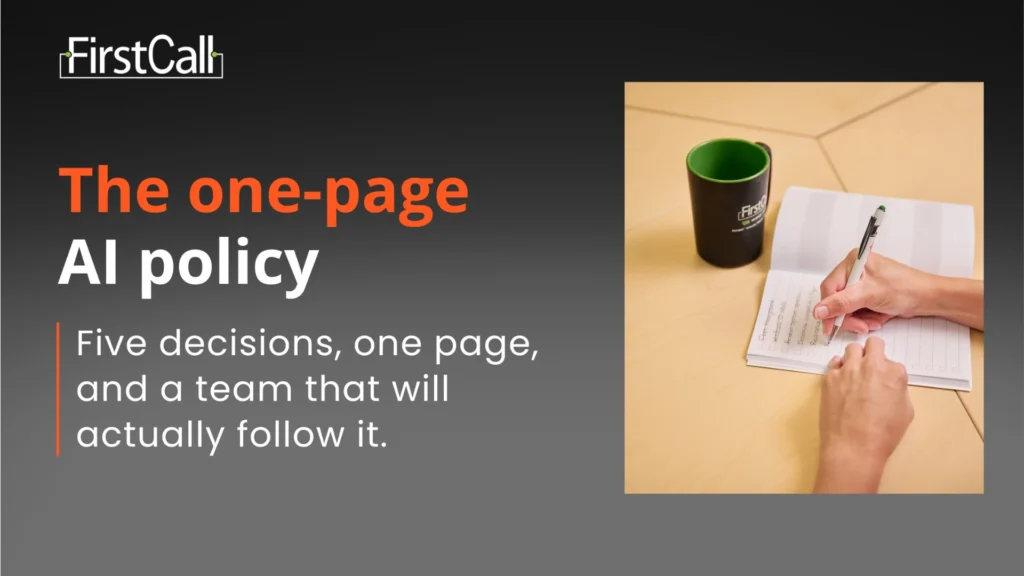
The One-Page AI Policy Your Team Will Actually Follow
Last week, I grabbed coffee with a CEO who couldn’t stop gushing about their company’s latest AI implementation. They were rattling off stats about how it had transformed their customer service department—until I threw out one simple question: “Who’s responsible when the AI screws up?” Crickets.
Business Email Compromise: The Wire-Fraud Banks Miss
Business email compromise, known as BEC, is a scam where an attacker impersonates a trusted contact, often by email, to trick someone into wiring money or sharing sensitive data. It does not require breaking into your network, which is exactly why it is harder to catch, and for many community banks, more expensive than ransomware.
Your Vendor Had a Cyber Incident. Now What?
If a vendor you rely on has a cyber incident, your first job is finding out exactly what data or systems of yours that vendor could reach. Don’t wait for an official notification letter to start looking. Most community banks and credit unions in Montana don’t have a documented answer to that question until an examiner asks for one.
Cybersecurity Services: Frequently Asked Questions
Questions We Hear Most Often
First Call provides advanced cybersecurity and compliance services including Endpoint Detection and Response (EDR), Security Information and Event Management (SIEM), Security Operations Center (SOC) monitoring, Managed Detection and Response (MDR), virtual CISO (vCISO) services, Security Alignment Manager (SAM) sessions, compliance operations, incident response planning, and CMMC readiness support for DOD contractors.
The NIST CSF is a set of guidelines developed by the National Institute of Standards and Technology to help organizations manage cybersecurity risk. Version 2.0, released in 2024, has six functions: Govern, Identify, Protect, Detect, Respond, and Recover. Organizations not subject to specific regulatory frameworks often use the NIST CSF as their baseline. If you're subject to HIPAA, CMMC, CJIS, or FERPA, those frameworks take precedence, though they align closely with NIST CSF principles.
The Cybersecurity Maturity Model Certification (CMMC) applies to organizations in the Defense Industrial Base, meaning any company holding DOD contracts or handling Controlled Unclassified Information. CMMC has three levels. Most small contractors fall under Level 1 or Level 2. Compliance requirements are being phased into contracts now. If you handle CUI under a federal contract, you need to understand where you stand. The CMMC Readiness Checklist is a good starting point.
A vCISO is a Virtual Chief Information Security Officer, meaning a senior security professional who works with your organization on a part-time basis, providing the strategic security oversight that larger organizations have in-house. For Montana businesses that need experienced security leadership but can't justify the cost of a full-time hire, a vCISO is usually the practical answer. If your organization has compliance obligations such as CMMC or HIPAA, a vCISO is typically essential to running the compliance program properly.
The cost depends on your organization's size, your industry's compliance requirements, and the level of ongoing monitoring and management you need. A scoped Security Stack Challenge is the fastest way to get an accurate number. It maps your current posture against your requirements and gives you a clear cost picture, with no obligation.
EDR (Endpoint Detection and Response) monitors individual devices for threats and responds to them. SIEM (Security Information and Event Management) aggregates log data from across your environment to detect patterns that individual device monitoring would miss. SOC (Security Operations Center) is the team monitoring the SIEM and responding to alerts. MDR (Managed Detection and Response) combines these with active threat hunting. These layers address different parts of the detection and response cycle and work best together.
If you're in a high-risk industry, hold sensitive data, or are significantly dependent on technology for your operations, cyber insurance is worth serious consideration. The right coverage depends on what risk you're trying to transfer: ransomware payment and recovery, forensics and response costs, regulatory fines, or public relations costs. A cybersecurity risk assessment will help you understand your exposure and have a more informed conversation with your insurance broker.
Yes. Many of our cybersecurity clients have a general managed IT provider and bring us in specifically for security, compliance, and vCISO capability. We define responsibilities clearly at the start so there's no ambiguity about who owns what. If the current provider relationship needs to change as part of improving your security posture, we'll advise on that, but the starting point is always working with what's in place.
Isolate affected systems from the network to limit further spread, then call us. Don't attempt to investigate or clean up on your own, as this can destroy the forensic evidence needed to understand what happened and whether data was taken. If you have an incident response plan, activate it. If you don't, our team will walk you through the immediate steps.