
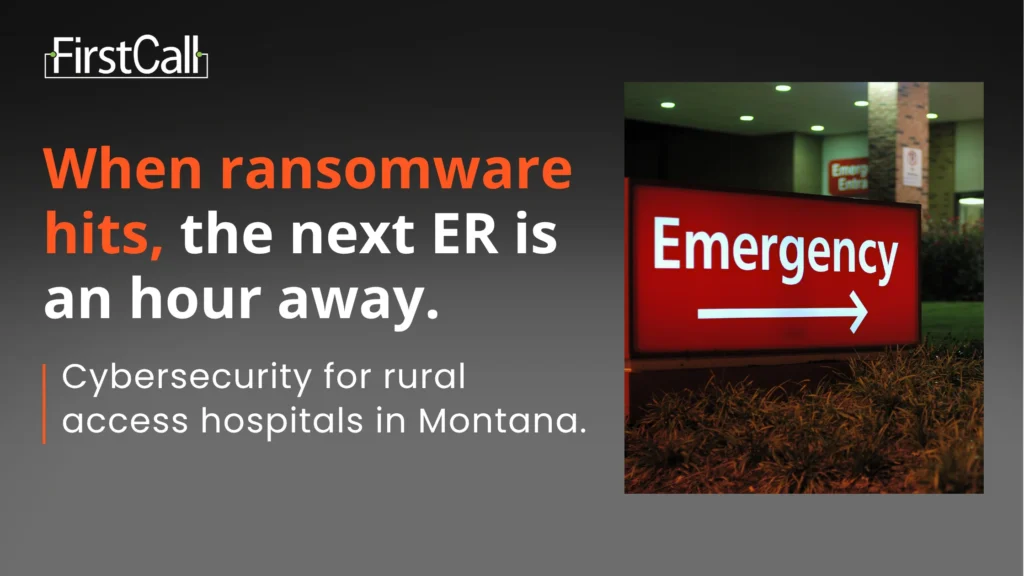
When ransomware takes down a hospital in a city, patients go to the hospital across town. When it happens to a rural access hospital in Montana, the next emergency room can be an hour or more away. That distance is why the cybersecurity conversation is different for the hospitals this post is about: critical access hospitals, rural emergency hospitals, and the rural health clinics attached to them.
The numbers say this is not a hypothetical. The National Rural Health Association reports that 84 percent of ransomware attacks on rural hospitals disrupted operations, 42 percent delayed or canceled scheduled care, and a third forced ambulances to divert. Attackers understand the math: the pressure to pay is highest where the community has no backup option.
Here is what a realistic defense looks like for a hospital with a small team and a smaller budget, including the help that costs nothing.
Why attackers go after small hospitals
It would be comforting to think attackers skip small targets, and the opposite is true. A critical access hospital holds the same protected health information as a large health system, usually behind fewer defenses, watched by fewer people. Most ransomware is sprayed broadly rather than aimed, so “too small to be worth it” offers no protection at all, and the attacks that are aimed favor victims who cannot afford downtime. A hospital whose community depends on it absolutely cannot.
Montana sharpens every one of those pressures. Communities sit far apart, winter makes the distances longer, and the hospital is often the town’s largest employer as well as its safety net, so an outage lands on the whole community at once.
The typical rural hospital IT department makes the problem concrete: one or two capable people responsible for everything from the EHR to the wireless in the ER, with security competing for attention against everything that beeps. Nobody in that position can also be a full-time security team, and no one should expect them to be.
What IT support for a rural access hospital has to cover
Strip away the vendor language and the job has four parts:
- Keeping care systems available. The EHR, scheduling, lab interfaces, and communications need to work during care hours, which in a hospital means all of them. Support has to be built around that, with monitoring and patching happening continuously rather than when someone gets a free afternoon.
- The HIPAA security risk assessment. An annual, documented risk assessment is required under HIPAA and remains the deficiency OCR cites most often in enforcement. It is also the best budgeting tool a small hospital has, because it ranks the gaps so limited dollars go where they matter. With proposed HIPAA Security Rule updates expected to make measures like multifactor authentication and encryption mandatory, a current assessment shows you what is coming before it is enforceable. We covered the rule change in detail in our breakdown of AI implementation risks under HIPAA.
- Ransomware readiness you have actually tested. Backups that have been restored at least once, rather than only scheduled. Downtime procedures clinical staff have practiced. Multifactor authentication everywhere that matters. Endpoint detection with a human watching the alerts. A response plan with names in it. Nothing on that list is exotic, and together those decisions are the difference between a bad week and a diverted ambulance.
- A bench for the big moments. Projects, incidents, and audits are when one IT person needs five. Co-managed support exists for exactly this: depth behind your people, never their replacement.
The free help most Montana hospitals have not claimed
Since 2024, Microsoft and Google have offered rural hospitals free security assessments, staff training, and steep product discounts, with nonprofit pricing specifically for critical access and rural emergency hospitals. More than 550 rural hospitals have joined Microsoft’s program alone, and the American Hospital Association and National Rural Health Association are involved in both.
Microsoft’s early findings from those free assessments are worth hearing on their own: most participating rural hospitals had not yet implemented basics like email security and multifactor authentication. If that describes your hospital, it also describes most of your peers, and the fixes are more affordable now than they have ever been.
These are real resources, and most Montana hospitals qualify. The honest caveat: programs do not implement themselves. A discounted security tool still needs someone to deploy it, configure it, and watch it, and a free assessment is only useful if its findings land in a plan someone owns. Bring the question to a 30-minute conversation with our CEO: what your hospital qualifies for, and how it fits into a setup that holds together.
The budget conversation this belongs in
If you are building the 2027 budget right now, this whole subject is a line item, and November is the right time to place it. Analog phone lines are being retired, Windows 10 machines now carry escalating per-device fees, and cyber insurance renewals have become control audits. We walked through all of it in Budgeting for Healthcare IT Services: What Your End-of-Year Plan Should Cover, which pairs with this post: that one says when and how much, this one says what and why.
Where to start
Two ways in, depending on how much certainty you want first. The First Call TechStack Challenge takes 20 minutes and scores how your technology, people, and security line up, with a prioritized plan at the end. Or go straight to the specifics of your hospital on our rural hospital cybersecurity services page.
First Call has supported Montana organizations for 25 years, and our healthcare home ground is the smaller facility: critical access hospitals like Mineral Community Hospital, rural health clinics, independent practices, and home care organizations. Standing shoulder to shoulder with a small hospital team is what our co-managed model was built for.
FAQ
What is a rural access hospital?
The hospitals that keep care available outside Montana’s cities: critical access hospitals (25 beds or fewer, located away from other hospitals), rural emergency hospitals, and the rural health clinics attached to them. Most hospitals in Montana fall into these categories.
Do small rural hospitals really get targeted by cyberattacks?
Yes, and often because they are small. Most ransomware is distributed indiscriminately, and targeted attacks favor organizations under pressure to restore service fast. The National Rural Health Association found 84 percent of ransomware attacks on rural hospitals disrupted operations, and a third forced ambulance diversion.
Are the Microsoft and Google rural hospital cybersecurity programs legitimate?
Yes. Both launched in 2024 with the American Hospital Association and the National Rural Health Association involved, offering free or deeply discounted security services with nonprofit pricing for critical access and rural emergency hospitals. Working out what your hospital qualifies for is a fair thing to ask us in a first conversation.
Can a critical access hospital afford real cybersecurity?
Usually, yes, once three things are counted: the free and discounted programs, a risk assessment that ranks spending instead of spreading it, and a co-managed split that adds depth behind existing staff instead of new headcount. The expensive version of cybersecurity is the one bought after an incident.