
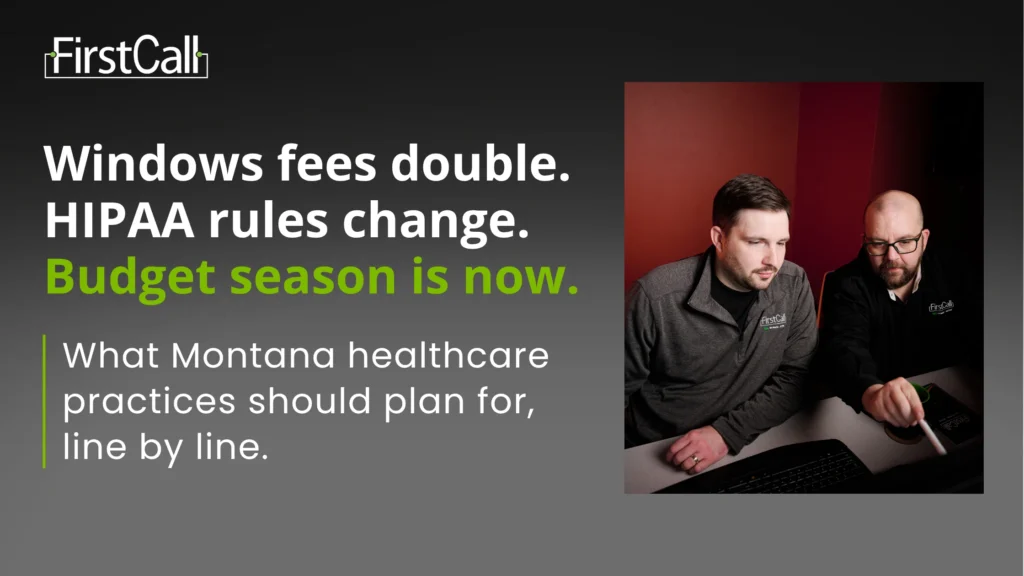
Most healthcare organizations build next year’s budget in November and December, and most IT line items get carried over from last year with a small increase. That worked when the technology picture changed slowly. Heading into 2027, it does not: there is a vendor deadline with a price that doubles, a federal rule in motion, and an industry that has led breach costs for thirteen straight years. The budget you write in the next few weeks decides how well your practice absorbs all three.
Here is what an end-of-year healthcare IT plan should cover, line by line.
1. The compliance work regulators actually check
Start with the items an auditor or investigator asks about first, because they are cheap compared to what skipping them costs.
- The HIPAA security risk assessment. An annual, documented Security Risk Analysis is required under HIPAA, and a missing or stale one remains the deficiency OCR cites most often in its enforcement actions. If yours predates your last major system change, it is stale. Budget for it as a recurring line, not a one-time project.
- A contingency for the HIPAA Security Rule update. The proposed update, published in January 2025, would make requirements like multifactor authentication, encryption, and asset inventories mandatory rather than addressable. It is not final yet, and the final version is widely expected in 2027. You do not need to fund full implementation today, but a budget with zero flexibility for it is a budget you will be rewriting mid-year. We covered what the proposal means for AI and security practices in our breakdown of AI implementation risks under HIPAA.
- Security awareness training. Phishing is still the front door for most healthcare incidents, and training is one of the three priorities federal regulators keep naming. It is also one of the smallest numbers in this list.
2. The deadline already on your calendar: Windows 10
Microsoft ended free support for Windows 10 in October 2025. Any device still running it only gets security patches through the paid Extended Security Updates program, and that program is built to push you off the platform: year one cost $61 per device, year two costs $122 per device through October 2027, year three doubles again to $244, and the fees are cumulative if you enroll late. After October 2028 there are no more patches at any price.
For a clinic, this is more than a licensing nuisance. An unpatched operating system touching patient data is exactly the kind of known, documented risk an SRA has to flag and a breach investigation will surface. Count the Windows 10 devices you still have, price the ESU fees against replacement hardware, and put the migration in the 2027 budget on your schedule. Waiting converts a planned refresh into an emergency purchase.
3. Security spending, priced against the alternative
IBM’s 2026 Cost of a Data Breach Report puts the average healthcare breach at $6.64 million, the highest of any industry for the thirteenth consecutive year. The same report found 39 percent of organizations were hit by ransomware and that breaches now take 247 days on average to identify and contain.
Your practice is not an average, and a small clinic will never see a seven-figure invoice in one line. The damage arrives proportionally instead: downtime during which you cannot see patients, notification costs, legal review, and the trust of a community that knows you by name. The budget conversation gets easier when security controls are priced against that, rather than treated as an IT wish list. The controls that matter most are the unglamorous ones: multifactor authentication everywhere, endpoint detection, tested backups, and someone actually watching the alerts.
4. The line item that did not exist two budgets ago: AI
By now, someone in your organization is using AI tools, with or without a policy. The budget question for 2027 has three parts: which tools you will pay for and approve, who reviews vendor agreements so that any AI tool touching patient information has a business associate agreement behind it, and what training keeps staff from pasting the wrong thing into the wrong tool. None of these are large numbers. All of them are smaller than explaining an unauthorized disclosure to OCR. Our plain-English piece on what never belongs in AI tools is a useful companion for staff.
5. Cyber insurance, and what renewal now requires
Cyber insurance renewals have become control audits: carriers increasingly require MFA, endpoint detection, and tested backups before they will quote, and they verify claims more aggressively than they used to. Budget for the premium, but also for closing whatever gap your carrier’s questionnaire exposes, because the questionnaire is a preview of what a claims adjuster will check after an incident.
6. The unglamorous lines that keep the lights on
The categories above are the ones that changed. The rest of the budget is the steady work: a staggered hardware refresh so no single year carries the whole fleet, support that answers when the front desk calls at 7:45 on a Monday, network and backup infrastructure, and the EHR costs your vendor sets whether you budget for them or not. If your EHR or file storage has moved to the cloud, healthcare cloud security deserves its own line: the hosting vendor secures the platform, but access controls, configuration, and backups of your data stay your responsibility, and your risk assessment has to cover them. If these lines have stayed flat through three years of growth, that usually means deferred spending, and deferred spending comes due all at once.
How to tell if the plan holds together
A useful end-of-year test: sort every IT line into four buckets, keep us running, keep us compliant, reduce our risk, and move us forward. A healthy healthcare IT budget has something in all four. A budget that is all bucket one is how practices end up funding 2026 technology with 2022 defenses.
This is the planning work we do with Montana healthcare organizations every fall, from independent clinics to community health centers. One of them, Better Community Healthcare, Powered by Managed Services, shows what the outcome looks like when the budget and the technology plan are the same document. There is more on how those partnerships work in How Healthcare Organizations Benefit From IT Partnerships.
Where to start
If you want a baseline before the budget locks, the First Call TechStack Challenge takes 20 minutes and scores how your technology, people, and security line up. You leave with the score and a prioritized plan, which is a decent skeleton for the budget itself. First Call has supported Montana organizations for 25 years, and healthcare budgets are a conversation we are glad to have before December, when there is still room to plan.
FAQ
How much should a medical practice spend on IT?
Published benchmarks vary too widely to be useful as a target, and chasing a percentage misses the point. A better test is coverage: does the budget fund compliance work (including an annual Security Risk Analysis), security controls your insurer and regulators expect, a hardware refresh that retires unsupported systems, and support your staff actually use? A smaller budget that covers all four beats a larger one that is all hardware.
Is it still safe to run Windows 10 in a clinic?
Only with paid Extended Security Updates, and the economics worsen every year: $122 per device through October 2027, $244 the year after, then no patches at any price. An unsupported operating system handling patient data is also a documented risk your Security Risk Analysis has to flag. For most practices, replacement costs less than a second and third year of fees plus the audit exposure.
Do we need to budget for the new HIPAA Security Rule now?
The update is still a proposal, and the final rule is widely expected in 2027. The sensible move for this budget cycle is a contingency, not full implementation: fund the things the proposal and your insurer already agree on, such as multifactor authentication and encryption, and leave room to respond when the final text lands.
Does cyber insurance replace security spending?
No. Carriers now require the core controls before they will quote, so the policy sits on top of the spending rather than substituting for it, and a claim can be denied if the controls on the application were not real. Treat the insurer’s questionnaire as a minimum standard, then insure what remains.